
The Early Decisions That Quietly Determine Success or Failure in Combination Product Development
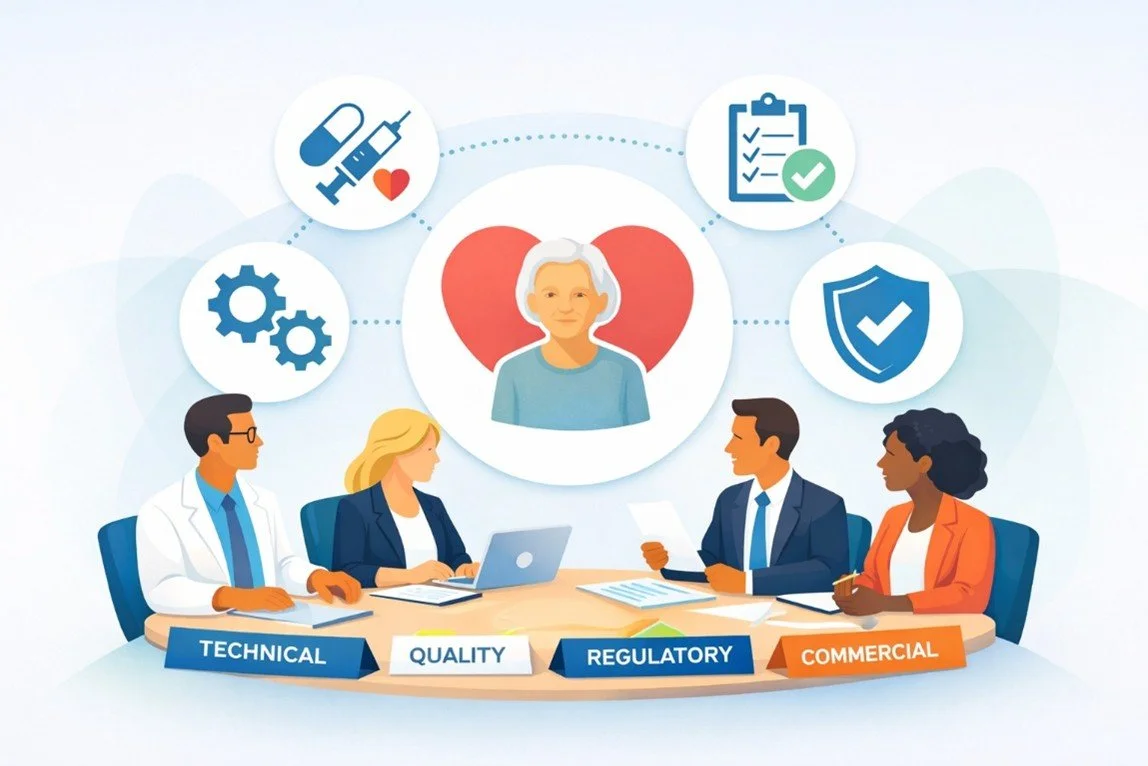
Collaborative decision-making across Technical, Quality, Regulatory, and Commercial teams to advance patient care.
“Early decisions in combination product development ripple through the entire programme—get them wrong, and months of rework and delay in approval follow.”
Why This Topic Matters
Across the industry, it’s common to see programmes where teams finalise a drug–device combination concept before fully considering the implications across all three pillars of success: commercial, technical/quality, and regulatory. On paper, plans seemed straightforward—but early assumptions about design, testing, market priorities, competitors and regional classification could cause significant delays and ultimately slow market uptake.
Surfacing these issues in early cross-functional discussions avoids unnecessary work, clarifies documentation needs, and aligns expectations. Combination products sit at the intersection of drugs, devices, and sometimes biologics. Decisions about formulation, delivery method, usability, and market positioning have regulatory consequences across all three pillars.
Integrating thinking from the outset—supported by structured approaches like Quality Function Deployment (QFD) and informed by the competitive landscape—helps teams align user needs, design choices, and regulatory strategy early, preventing avoidable delays and reducing development risk.
After years working on combination product programmes, we have observed that the most successful teams aren’t necessarily the most technically brilliant—they operate in a culture that encourages early collaboration, patient-centric thinking, proactive judgment, and transparency around risk. In these environments, stakeholders are aligned before design decisions, testing strategies, or timelines are finalized, reducing friction and enabling robust decision-making.
“Success in combination products isn’t about technical brilliance—it’s about patient-centric thinking, alignment, transparency, and foresight, enabled by a culture that supports collaboration across commercial, technical, and regulatory pillars.”
The Three Pillars of Combination Product Success
Here’s a visual representation of the three pillars that must be aligned early:
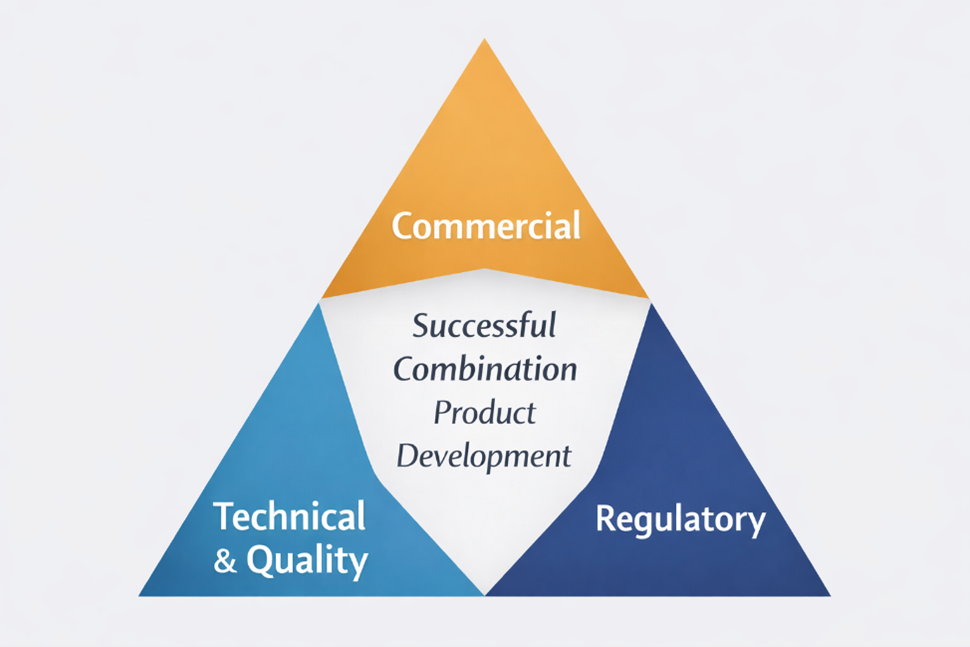
Triangle showing Commercial, Technical & Quality, and Regulatory pillars with ‘Successful Combination Product Development’ at the centre.
This triangle illustrates that Commercial, Technical/Quality, and Regulatory pillars are interconnected. Misalignment in any one area can create downstream delays, risk, or rework. Early integration ensures decisions across design, testing, and strategy are cohesive, patient-focused and ensure optimal product performance.
The Challenge: What’s Really Going Wrong
The pattern is familiar: teams dive into development with enthusiasm, but strategy across the three pillars is unclear, reactive, and siloed. Decisions about formulation, device delivery approaches, testing, or market launch are often made independently, leaving gaps that only surface later.
Common misalignments across the three pillars:
Unspoken assumptions: Everyone assumes someone else is considering regulatory implications, technical feasibility, or market needs. For example, a device concept may progress assuming it is “well understood,” only for gaps in human factors data or combination product classification to emerge during submission.
Conflicting priorities: Technical teams prioritize speed and feasibility, commercial teams focus on market differentiation, and regulatory anticipates documentation, testing, and classification requirements. These drivers are rarely discussed explicitly, allowing tension to build until late-stage requests force rework or delays.
Late surprises from early choices: Decisions on usability, testing scope, or supplier selection can trigger downstream impacts. Additional human factors, testing data or extractables and leachables testing late in development can delay submission across multiple regions.
A changing regulatory landscape: Regulations and standards evolve continuously. Without an integrated strategy, teams risk discovering too late that new guidance affects classification, clinical requirements, or post-market obligations. Proactively monitoring updates and assessing their impact ensures compliance, reduces delays, and keeps development on track
Competitive slippage: While teams revisit decisions or resolve late-stage issues, competitors with better early alignment may progress more smoothly, reaching milestones, approvals, or market entry first – reducing differentiation, pricing power, and return on investment.
“The root problem isn’t lack of expertise—it’s the absence of early, deliberate alignment on strategy, risk, and decision-making across commercial, technical, and regulatory pillars.”
Why This Matters: Impact on Timelines, Risk, and Teams
Without early judgment integrated across cross functional strategy, IP differentiation, and QFD:
Development delays become inevitable as regulatory expectations, IP positioning, and design controls are addressed too late.
Submissions attract unexpected questions, increasing regulatory and commercial risk.
IP differentiation is weakened, and QFD becomes reactive, leading teams to expend energy on rework instead of clinical execution or business priorities.
Cross-functional tension escalates as regulatory, technical/quality, IP, and commercial teams operate from different assumptions, eroding trust and momentum.
Compliance and business sustainability are also put at risk because evolving regulatory standards and market requirements over the next decade may jeopardize variations, lifecycle extensions, and long-term value.
“Cross-functional alignment is not optional—it is foundational to defensible IP, predictable timelines, and sustained business confidence.”
What Experienced Teams Do Differently
High-performing teams act strategically—not tactically—and anchor decisions in patient need first, using that anchor to align commercial, technical/quality, and regulatory priorities:
Start with patient need: Patient outcomes, usability, and risk tolerance define the target product profile. Commercial, technical, and regulatory priorities are aligned—not traded off.
Recognize that innovation is cross-functional: Breakthrough solutions often emerge where commercial, technical, and regulatory perspectives intersect. Experienced teams cultivate collaboration across functions, understanding that patient-focused innovation drives both value and profitability.
Align expectations across all pillars: Early discussions ensure patient needs, commercial objectives, technical feasibility, IP differentiation, and regulatory strategy are considered together rather than sequentially.
Use regulatory strategy as a living framework and strategic advantage: Regulatory judgment guides design, testing, and development iteratively, ensuring patient-centric claims remain approvable while balancing technical and commercial realities. If positioned correctly, it can be used as a strategic advantage.
Leverage QFD to anticipate and manage risk: QFD translates patient and user needs into critical design and process requirements, helping teams identify risks, prioritize development efforts, and align commercial, regulatory, and technical/quality priorities early—before issues escalate.
Embed cross-functional decision-making: Material choices, usability approaches, control strategies, and testing plans are debated and reconciled across technical/quality, regulatory, and commercial perspectives.
Challenge assumptions proactively: Early questioning of classification, intended use, target populations, testing scope, or delivery methods prevents late-stage conflict and protects both patient and business value.
“When patient need anchors alignment across commercial, technical/quality, and regulatory pillars progress becomes predictable and confident.”
Common Misconceptions or Pitfalls
Even experienced teams fall into traps:
Regulatory is just a final check—early engagement turns compliance into a strategic advantage, enabling patient-focused, innovative design rather than just meeting minimum requirements.
Questions can wait until pre-submission—delaying discussions often makes issues worse.
One-size-fits-all strategy works globally—nuanced, early thinking is essential for multi-region programs.
“Regulatory input is a compass, not a gatekeeper—it guides success across commercial, technical, and regulatory pillars. Far from being just a cost to minimize, it is an area in which teams can innovate; when used strategically, regulatory insight becomes a competitive advantage.”
Key Takeaway
Early, informed, cross-functional thinking provides upstream success and prevents downstream problems. Teams that make deliberate, patient-centric judgments avoid unnecessary rework, reduce stress, and accelerate development—without compromising compliance or business value.
“Good leadership isn’t about chasing problems—it’s about preventing them across all three pillars strategically and proactively keeping patients in mind.”
Closing Perspective
Combination product development is inherently complex, but unpredictability isn’t inevitable. Leaders who prioritize patient outcomes while driving early engagement, cross-functional alignment, and proactive risk management create smoother, faster, and more confident programs.
Keeping the end user in mind—and imagining someone close to you relying on this product—ensures that every decision on design, risk, or regulatory strategy delivers meaningful impact. A few thoughtful conversations at the start can save months of revision, rework, and frustration, setting the stage for global program success.
At CPMD Consulting Ltd., we guide teams to align regulatory, technical, and commercial priorities early, transforming patient and user insights into actionable design and risk decisions. The result: streamlined programs, predictable timelines, and patient-focused outcomes.
“Sustained alignment-within teams and beyond organisational boundaries- anchored in patient outcomes and real-world impact creates the foundation for confident, purposeful, and transformative development.”
Author: Combination Product and Medical Devices Consulting Ltd.
Editorial support: The blog was prepared with the assistance of FSI.
Disclaimer: The perspectives shared here reflect general industry experience and do not reference any specific company, product, or confidential programme.
